Selling AI to Skeptics

14 min apply 4 sections
Step 1 of 4

WHY WHY This Matters

Every AI initiative faces skeptics. And they're not wrong to be skeptical:

  • 85% of AI projects fail to deliver business value
  • Most organizations have seen "innovation theater" before
  • AI feels threatening to people whose work might change
  • The technology is genuinely uncertain and evolving

The operators who transform organizations aren't the ones with the best technical skills—they're the ones who can bring skeptics along. You need to sell the vision without overselling the technology.
Step 2 of 4

WHAT WHAT You Need to Know

The Skeptic Taxonomy

The Objection Playbook

Every AI pitch surfaces predictable objections. Prepare for them:

Objection Weak Response Strong Response
"AI makes stuff up" "We'll prompt carefully" "You're right. That's why we'll use AI for X where hallucination risk is manageable, not for Y where it's critical"
"It's too expensive" "But look at these savings!" "Let me show the 90-day pilot cost vs. the cost of not solving this problem"
"We don't have the data" "We can start with what we have" "We don't need perfect data—we need enough data to prove the concept, then iterate"
"Compliance won't allow it" "Other companies are doing it" "Here's how we'd work with legal and compliance from day one—they're part of the pilot team"
"What about security?" "These tools are enterprise-grade" "Valid concern. Here's our security review process and the specific controls we'll implement"

The Risk Paradox

Here's the insight most operators miss:

Skeptics think about risk asymmetrically:

  • Risk of doing something new (very salient)
  • Risk of doing nothing (often invisible)

Your job is to make the status quo risk visible.

The Pilot Pitch Pattern

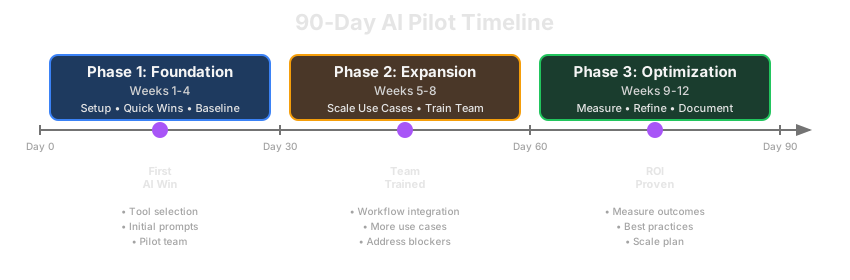
The most effective way to move skeptics: propose a bounded pilot.

90-Day AI Pilot Timeline showing three phases: Foundation (weeks 1-4), Expansion (weeks 5-8), and Optimization (weeks 9-12)
The 90-Day Pilot Timeline: Foundation → Expansion → Optimization

Why this works:

  1. Bounded risk: 90 days, small team, limited scope
  2. Clear decision point: Built-in evaluation moment
  3. Permission to fail: "Pivot or stop" is an acceptable outcome
  4. Data over opinions: Metrics settle debates

Quick Wins Strategy

Skeptics need to see results before they believe. Choose initial use cases that:

Criterion Why It Matters
High visibility Stakeholders notice the impact
Low risk Failure won't be catastrophic
Short cycle Results visible in weeks, not months
Measurable Clear before/after comparison
Volunteer participants Early adopters, not conscripts

Good first pilots:

  • Internal document search/Q&A
  • Meeting summarization
  • First-draft content generation
  • Data formatting/transformation
  • Customer inquiry triage

Bad first pilots:

  • Customer-facing production systems
  • High-stakes decision automation
  • Anything requiring perfect accuracy
  • Complex integrations

The Influence Map

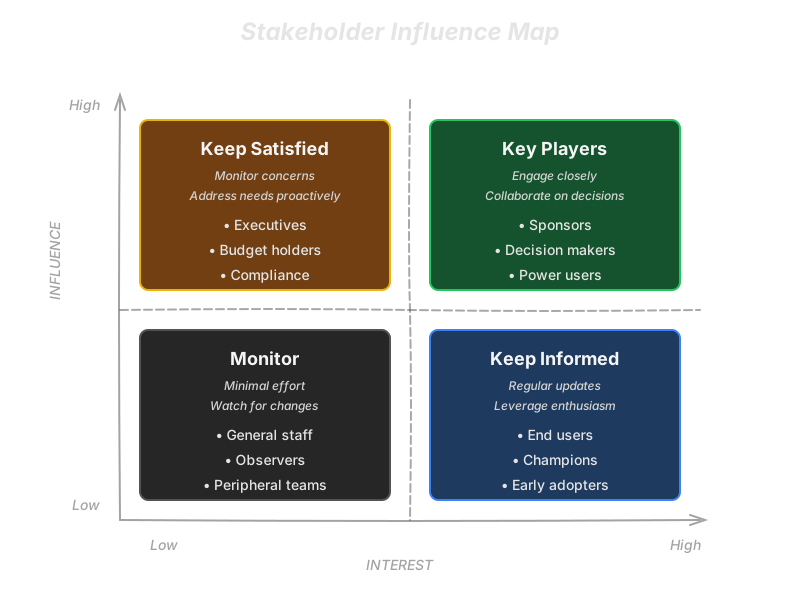
Before pitching, map your stakeholders:

Stakeholder Influence Map showing four quadrants: Key Players (high power, high interest), Keep Satisfied (high power, low interest), Keep Informed (low power, high interest), and Monitor (low power, low interest)
Stakeholder Influence Map: Map your stakeholders before pitching
Quadrant Strategy
High Power / High Interest Partner: Deep involvement, co-design the pilot
High Power / Low Interest Manage Closely: Regular updates, no surprises
Low Power / High Interest Keep Informed: Share progress, recruit as champions
Low Power / Low Interest Keep Satisfied: Light touch, occasional updates

Key Concepts

Key Concept

skeptic types

Not all resistance is the same. Different skeptics require different approaches:

The Risk-Averse Leader

  • Concern: "What if this goes wrong?"
  • Motivation: Protecting their reputation and team
  • Approach: Lead with risk mitigation, not upside

The Burned Veteran

  • Concern: "We tried this before. It failed."
  • Motivation: Not wanting to repeat past pain
  • Approach: Acknowledge past failures, explain what's different

The Budget Guardian

  • Concern: "How much will this cost and for how long?"
  • Motivation: Protecting resources, managing optics
  • Approach: Clear ROI, phased investment, quick wins

The Threatened Expert

  • Concern: "Is this replacing me/my team?"
  • Motivation: Job security, professional identity
  • Approach: Augmentation narrative, new opportunities

The Technical Purist

  • Concern: "The technology isn't mature enough."
  • Motivation: Technical standards, avoiding shortcuts
  • Approach: Acknowledge limitations, focus on bounded use cases
Key Concept

status quo risk

Frame the choice correctly:

Not: "Should we try AI?" But: "Which risk do we accept?"

Option Risk
Try AI Pilot fails, we learn, iterate
Do nothing Competitors gain 18 months of learning while we wait

Every month you don't learn is competitive debt you're accumulating.

Step 3 of 4

HOW HOW to Apply This

Exercise: Craft Your Pitch

The Pitch Template

AI INITIATIVE PITCH

FOR [Skeptic Name/Role]

THE PROBLEM WE'RE SOLVING
- Current state: [What's happening now]
- Cost of status quo: [Quantified if possible]
- What we're missing: [Opportunity cost]

WHY NOW
- What's changed: [Technology, competition, capability]
- Risk of waiting: [Competitive, operational]

THE PROPOSAL
- Pilot scope: [Bounded description]
- Duration: [90 days typical]
- Investment: [Time, money, attention]
- Who's involved: [Team members]

SUCCESS LOOKS LIKE
- Metric 1: [Specific, measurable]
- Metric 2: [Specific, measurable]
- Qualitative: [User satisfaction, adoption]

RISK MITIGATION
- Concern 1 → Mitigation
- Concern 2 → Mitigation
- Kill criteria: [When we would stop]

THE ASK
- Approval for: [Specific scope]
- Resources needed: [Specific asks]
- Decision date: [When you need an answer]

Common Selling Mistakes

Mistake Problem Correction
Leading with technology Skeptics don't care about AI—they care about outcomes Lead with the problem and business value
Overselling capabilities Destroys credibility when limitations emerge Be honest about what AI can and cannot do
Ignoring past failures Feels dismissive, breeds resentment Acknowledge past pain, explain what's different
Asking for too much Big asks get rejected Start small, prove value, expand
Skipping the pilot No evidence to support claims Always propose bounded experiments
Underestimating politics Ignoring stakeholder dynamics Map influence, build coalitions

Self-Check


Practice Exercises

You want to implement an AI assistant to help your team summarize customer feedback from support tickets and identify trending issues.

The skeptic: Your VP of Customer Success is concerned about:

  • "What if we miss critical issues because AI summarized them wrong?"
  • "My team is already stretched thin—they can't learn new tools"
  • "We tried a chatbot two years ago and it was a disaster"

Build your pitch:

  1. Acknowledge the concern (don't dismiss):

    • What specifically would you say to validate their past experience?
  2. Reframe the risk:

    • What is the cost of the current process?
    • What are they missing without better synthesis?
  3. Propose a bounded pilot:

    • Scope: Which subset of tickets?
    • Duration: How long?
    • Participants: Who?
    • Success metrics: What would prove value?
  4. Address the "different this time" question:

    • What has changed since their chatbot failure?
    • Why is this use case different?
  5. Offer an exit ramp:

    • What's the kill criteria?
    • How will they know to stop if it's not working?
Step 4 of 4

GENERIC Up Next

In Module 5.2: Building AI-Capable Teams, you'll learn how to assess team readiness, identify skill gaps, and create learning paths that develop AI fluency across your organization.

Module Complete!

You've reached the end of this module. Review the checklist below to ensure you've understood the key concepts.

Progress Checklist

0/6
0% Complete
0/4 Sections
0/2 Concepts
0/1 Exercises