Building AI-Capable Teams

13 min apply 4 sections
Step 1 of 4

WHY WHY This Matters

The limiting factor for AI adoption isn't technology—it's people. Organizations fail at AI not because the tools don't work, but because:

  • Teams don't know what's possible
  • Leaders can't evaluate AI outputs
  • Skills are concentrated in too few people
  • Training focuses on tools, not judgment

You can't scale AI with one expert and a dozen bystanders. You need distributed AI capability across the team.

Step 2 of 4

WHAT WHAT You Need to Know

The AI Fluency Spectrum

The Capability Assessment

Before building capability, assess your current state:

Individual Assessment Framework:

Dimension Questions to Assess
Awareness Can they explain what generative AI does? Do they know current capabilities and limitations?
Tool Proficiency Can they use at least one AI tool independently? How often do they use it?
Prompt Craft Can they write prompts that get useful outputs? Do they iterate effectively?
Output Judgment Can they evaluate AI output quality? Do they know when to trust vs. verify?
Integration Can they combine AI with their existing workflow? Do they know when NOT to use AI?
Teaching Can they help colleagues use AI effectively? Do they share techniques?

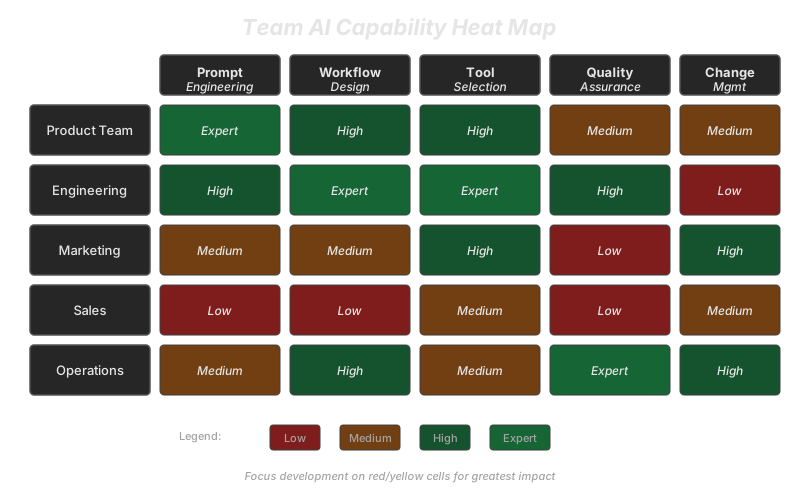
Team-Level Assessment:

Team AI Capability Heat Map showing team members rated across five capability dimensions: Prompt Engineering, Workflow Design, Tool Selection, Quality Assurance, and Change Management
Capability Heat Map: Identify skill gaps and training priorities at a glance

What the heat map reveals:

  • Single points of failure: Only Person D can build
  • Bottlenecks: Only 2 people can design workflows
  • Training priorities: Level 2 → 3 transition for most
  • Risk: Person D leaves = team can't iterate

The Learning Path Architecture

Don't train everyone on everything. Design role-specific paths:

Path 1: Core AI Literacy (Everyone)

  • What AI can and cannot do
  • How to prompt effectively
  • Evaluating output quality
  • Security and compliance basics
  • When to use AI vs. not

Path 2: Power User (Select Contributors)

  • Advanced prompting techniques
  • Multi-step workflows
  • Domain-specific applications
  • Quality frameworks
  • Sharing and documentation

Path 3: Workflow Designer (Team Leads)

  • Use case identification
  • Workflow design
  • Template creation
  • Training delivery
  • ROI measurement

Path 4: AI Builder (Technical Roles)

  • API integration
  • Custom fine-tuning
  • Evaluation systems
  • Architecture decisions
  • Technical risk management

Building vs. Buying Skills

Approach When to Use Trade-offs
Internal training Core team skills, long-term capability Takes time, variable quality
External courses Standard skills, credentialing Generic, may not fit context
Hire specialists Advanced technical roles, urgent needs Expensive, integration risk
Consultants Jumpstart, specific projects Knowledge walks out the door
Embedded learning Continuous improvement Requires culture change

The optimal mix:

  • Build internal training for Levels 1-3
  • Use external courses for credentialing and benchmarking
  • Hire for Level 4 if you need builders
  • Use consultants for specific projects, not ongoing capability

The Role Matrix

As AI capabilities mature, teams need new roles:

The Learning Culture Shift

Tools and training aren't enough. You need a culture that:

Encourages experimentation:

  • "Try it" is the default answer
  • Failed experiments are learning, not failure
  • Sharing attempts (successful and not) is celebrated

Normalizes AI use:

  • AI assistance is expected, not exceptional
  • "I used AI to help with this" is standard disclosure
  • Quality matters, not whether AI was involved

Values judgment over execution:

  • AI does the first draft
  • Humans provide direction and quality control
  • Critical thinking is the premium skill

Builds collectively:

  • Techniques are shared, not hoarded
  • Templates and prompts are team assets
  • Success stories spread fast

Key Concepts

Key Concept

fluency levels

Not everyone needs to be an AI engineer. But everyone needs some level of AI fluency:

Level 1: Aware

  • Knows AI exists and what it generally does
  • Can follow AI-generated outputs with guidance
  • Recognizes when AI might be useful
  • Typical role: All knowledge workers

Level 2: User

  • Can operate AI tools independently
  • Crafts effective prompts
  • Evaluates output quality
  • Knows when to trust vs. verify
  • Typical role: Individual contributors, analysts

Level 3: Designer

  • Creates AI workflows and templates
  • Defines use cases and requirements
  • Sets quality standards
  • Trains others on effective use
  • Typical role: Team leads, power users

Level 4: Builder

  • Integrates AI into systems
  • Customizes and fine-tunes models
  • Builds evaluation frameworks
  • Architects AI solutions
  • Typical role: Technical specialists

Level 5: Strategist

  • Sets AI vision and roadmap
  • Evaluates AI investments
  • Manages AI risk portfolio
  • Builds AI-native culture
  • Typical role: Directors, executives
Key Concept

ai team roles

Role Responsibility Skills Needed
AI Champion Evangelizes AI use, connects people to solutions Communication, pattern recognition, enthusiasm
Prompt Engineer Develops and maintains effective prompts and templates Domain knowledge, structured thinking, iteration
AI Quality Lead Sets standards, reviews outputs, manages hallucination risk Critical thinking, domain expertise, process design
Integration Developer Connects AI to existing systems and workflows Technical skills, API knowledge, system design
AI Trainer Develops and delivers AI training programs Teaching, documentation, patience
AI Ethics Lead Ensures responsible use, manages risk Ethics, compliance, policy development

Not all roles need dedicated people—many can be part-time or combined.

Step 3 of 4

HOW HOW to Apply This

Exercise: Team Capability Assessment

The 90-Day Capability Building Plan

90-DAY AI CAPABILITY PLAN

WEEK 1-2: Foundation
├─> Assess current team capability
├─> Identify 2-3 AI Champions
├─> Select initial tools and access
└─> Establish basic security guidelines

WEEK 3-4: Core Training
├─> AI literacy workshop (all team)
├─> Tool access and setup (all team)
├─> First hands-on exercises
└─> Q&A and troubleshooting

WEEK 5-8: Practice Period
├─> Weekly "AI office hours" (30 min)
├─> Use case identification
├─> Template development
├─> Peer sharing sessions

WEEK 9-10: Power User Development
├─> Advanced training for Champions
├─> Workflow design workshop
├─> Documentation and templates
└─> First workflow deployment

WEEK 11-12: Assessment and Planning
├─> Re-assess team capability
├─> Measure adoption metrics
├─> Identify next phase priorities
└─> Plan months 4-6

Common Capability Building Mistakes

Mistake Problem Correction
Training everyone the same Wastes time, frustrates experts Role-based learning paths
One-time training Skills decay without practice Ongoing practice and reinforcement
Tool-focused training Missing the judgment component Focus on when and why, not just how
No measurement Can't track progress Define clear capability metrics
Ignoring resistance Silent non-adoption Address concerns, create safe space
Moving too fast Overwhelms team Pace to absorption capacity

Self-Check


Practice Exercises

You lead a team of 6 people and want to build AI capability.

Step 1: Assess Current State

For each team member (or yourself + 5 hypothetical colleagues), rate on 1-5:

Person Awareness Tool Use Prompt Craft Output Judgment Integration
You
Person 2
Person 3
Person 4
Person 5
Person 6

Step 2: Identify Gaps

  • Where are the single points of failure?
  • What's the minimum viable distribution of skills?
  • Who are your potential AI Champions?

Step 3: Design Development Plan

For each gap, specify:

  • What skill needs to develop?
  • Who needs it?
  • How will they learn? (training, practice, coaching)
  • How will you measure progress?
  • What's the timeline?

Step 4: Create Success Metrics

  • How will you know capability is improving?
  • What behaviors should you see in 30/60/90 days?
Step 4 of 4

GENERIC Up Next

In Module 5.3: Project Scoping & Estimation, you'll learn how to accurately scope AI projects, estimate effort, and create delivery plans that set realistic expectations.

Module Complete!

You've reached the end of this module. Review the checklist below to ensure you've understood the key concepts.

Progress Checklist

0/6
0% Complete
0/4 Sections
0/2 Concepts
0/1 Exercises